Louise and Rob: Day One

We wake up after barely sleeping at all, Rob is anxious and excited as this is his first flight, and Louise is really nervous and excited because, well just because we’re finally going to Japan!

Bento

Bento is a single-portion meal that can be either homemade or takeout. Basically it's a pack-up, but Japanese style.

Louise and Rob: Day Two

We wake up jetlagged, but pleased we didn’t draw the blinds, the view is still amazing, and we can watch ant-sized Japanese people rushing to work while we feast on Milk Pocky, Koala’s March biscuits and odd textured buns masquerading as donuts, all washed down with cold coffee and grape Fanta.

Train Stations

No doubt you've heard all about Tokyo train stations. The horror stories of how busy they are, how confusing the maps are, how people get pushed onto rush hour trains. Forget all of your preconceptions - Tokyo has possibly the most efficient train station in the world

Louise and Rob: Day Three

We wake up super early again – a combination of jet lag and excitement, we’re going to Ueno Zoo today! This is one of the things we planned immediately when we decided to go to Tokyo, so we’re really looking forward to it, particularly because this will be the first time either of us have ever seen a panda.

Asakusa

Asakusa (浅草) is a district in Taitō, most famous for the Sensō-ji, a Buddhist temple. Asakusa is Tokyo's oldest geisha district and a former entertainment district. Asakusa's main attractions are a number of shrines and temples, including the Sensō-ji, a small carnival complex called Hanayashiki and traditional activities such as river cruises and rickshaw rides.

Showing posts with label anime. Show all posts

Sunday, 9 January 2011

Studio Ghibli Museum

Nestled in a park in Mitaka, Tokyo, is the Ghibli Museum (三鷹の森ジブリ美術館). The Mecca of anime fans everywhere, it's a wonderful celebration of the magic created by the studio through its many films. It was designed by Hayao Miyazaki (the director of many Ghibli films) himself, with the view of creating a museum that both young and old alike can get lost in.


Getting a ticket can be a little difficult if you are not based in Japan, however JTB (Japanese Travel Bureau) affiliates My Bus will sort you out tickets for just 1000JPY, about £8. It's worth remembering that the museum is very popular, so it's worth snapping up your tickets as soon as possible (My Bus release them 3 months in advance). However if you do want to chance it, and can understand written Japanese then tickets can be purchased at Lawson stores over in Japan. However I would recommend My Bus, as when tickets are bought from Lawson (although they are cheaper) they are timed tickets, so you only get 3 hours to look around, whereas when tickets are bought via My Bus you get the whole day to explore.

When you arrive in Mitaka you can either walk through the park to the museum, or grab the brilliantly decorated local bus service.


The museum itself is a hodgepodge of funny shaped little buildings, all crawling with ivy and other plant material, with lots of little surprises everywhere, from stained glass windows to small details such as taps and floor tiles.


 Upon arrival you get a nice surprise in the ticket booth, before (hopefully) realising that the real entrance is just a little further up the path. Once at the entrance a guide will check your passport details against your paper ticket, before allowing you to enter. Security is tight, but smiley.

 Photo from: Studio Ghibli Museum

Once you are allowed inside, there is an amazing fresco painted on the walls and ceiling of the entrance hall. After you've gaped at this for a little while you can approach the ticket desk and have your paper ticket swapped for a lovely proper ticket, featuring animation cells from one of Ghibli's films.

Then, you're in - properly! The main hall is full of shimmering lights and metalwork. It's clear from the beginning Miyazaki has put as much effort into the details here as he would his animations.
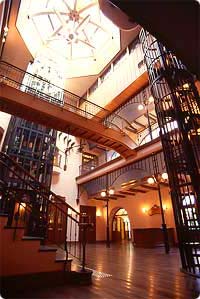
  Photo from: Studio Ghibli Museum

Moving on, there is a room featuring a series of animation-themed exhibits which change over time. However one mainstay seems to be a My Neighbour Totoro-themed zoetrope.
Photo from: Flixster

Up a floor is a mock up of an artist's studio which is stuffed to the gills with...well stuff. Random bits and pieces inspired by Miyazaki and Takahata's studios, as well as hundreds of colour sketches from the Ghibli films. 
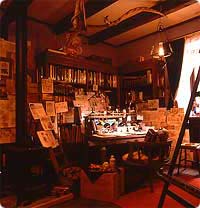
  Photo from: Studio Ghibli Museum

There's also a giant catbus room, where school-aged children can see what it is like to clamber aboard the furry animal (while making all the otaku adults jealous!)
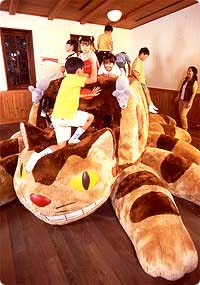
  Photo from: Studio Ghibli Museum

And one of the highlights of the museum is the Laputa-esque roof garden, complete with futuristic cube and giant robot soldier.
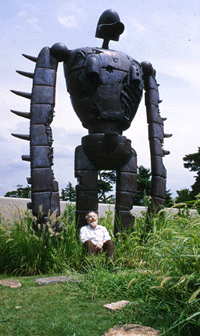
   Photo from: Studio Ghibli Museum

Be sure to take the time to check out the musical insect seats and ridiculously funny water fountain (press it - you'll see what we mean!) on your way up to the roof garden. 
Perhaps the best part of going to the museum is the chance to visit the Saturn Theatre - where you can view an exclusive Studio Ghibli short. These films are never shown anywhere else, so seeing one is really quite a special experience.
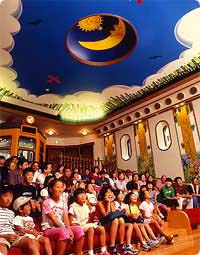
 Photo from: Studio Ghibli Museum

Once you have explored the museum you should head out to the roof terrace and either grab a quick snack (hotdogs, icecream and drinks) from the small hole in the wall servery or join the queue to get into the Straw Hat Cafe - which serves delicious local produce in sandwichs, soups and pastas as well as giant cakes and non-alcoholic cocktails. 


Photo from: Kaz

And then - possibly the best bit! - there are two shops to browse! Mamma Auito, which sells a variety of merchandise, including giant Totoro plushies, jigsaw puzzles and musical ornaments, and Trihawks, which sells beautiful Studio Ghibli art books alongside books recommened by Studio Ghibli members.
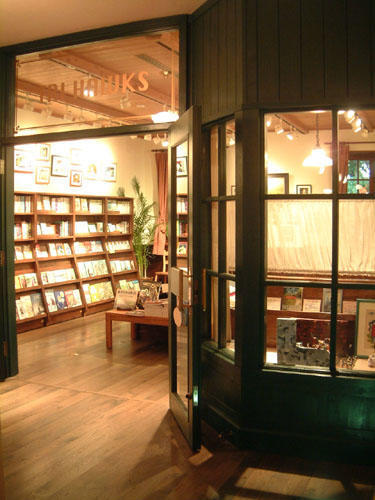
 Photo from: Studio Ghibli Museum

So take some time out, visit the Ghibli Museum in leafy Mitaka and remember what it is like to look through the eyes of a child.

Information

  • Open 10am-6pm 
  • Generally closed Tuesdays
  • Admission Fee: Adult: 1000JPY, 13-18 years old: 700JPY, 7-12 years old: 400JPY, 4-6 years old: 100 JPY
  • Local bus: 300JPY return
How To Get There


You can get to Mitaka from Shinjuku station by taking the JR Chuo line. The ride is approximately 20 minutes and costs under 500JPY.
You then take the Mitaka South Exit, from here you can walk through Inokashira Park or you can catch the community bus at the well-signposted bus stop just outside of the station (bus stop #9).

Anime


Anime (アニメ) is basically short for the English word "animation", which is appropriate because that's exactly what it is. As manga is to graphic novels, so anime is far more broad-ranging as a genre and in its reception than cartoons are in the UK.

So popular was it as a medium since the post-war period, and so skilled were the animators, that many of the kids' TV shows we grew up with were actually made in Japan - for instance The Moomins, The Mysterious Cities of Gold and ThunderCats, to name but a few, were all made there or with the help of Japanese experts in the field.

 GTO

Possibly some of the best examples of anime movies come from the always-excellent Studio Ghibli, such as Spirited Away, Howl's Moving Castle and Princess Mononoke. Notable TV series include Chobits, Great Teacher Onizuka,  Cowboy Bebop and Tokyo Mew Mew. This is by no means an exhaustive list, and the best way of finding your own favourites is to watch as much as possible - there's plenty to choose from!

Studio Ghibli

It would be foolish to not mention the Japanese anime powerhouse on this blog. Studio Ghibli are the animation studio who brought anime to global attention with the Academy Award-winning Spirited Away.


The studio was founded by Hayao Miyazaki, Isao Takahata and Toshio Suzuki in 1985 and shot to mainstream fame in Japan with films such as Nausicaa Of The Valley Of The Wind, Laputa: Castle In The Sky and Grave Of The Fireflies.

 
Studio Ghibli is so popular is Japan there are a large number of shops selling merchandise, and also a museum. Among the many and varied Ghibli merchandise on offer are stuffed toys, bento accessories, clothing, ornaments, music boxes, jigsaw puzzles, rubber-stamp sets, keyrings, plates, chopsticks, umbrellas, books, and almost everything else imaginable...

The films themselves are readily available around the world thanks to a distribution deal with Disney. They're even getting national releases in cinemas in the UK now. The DVDs always have the option of the original Japanese soundtrack with subtitles, or a dub by Disney.

Manga


Manga (漫画) refers to graphic novels and comic strips. Although often it's used outside of Japan to refer to Japanese animation, in the country itself "manga" is specific to print media.

In the UK, graphic novels tend to be both expensive, and quite niche. But in Japan manga is both ubiquitous and reasonably cheap. There are a number of categories of manga, which appeal to many different social groups - such as shojo (aimed at teenage girls), shonen (teen boys), seinen (men aged 18-40) and josei (late-teen to adult women). There are countless sub-categories within these, which relate to the themes, styles and the content.

Its appeal is so broad that it's not uncommon to see middle-aged salarymen or sucessful businesswomen reading the latest seinen or josei series on the commute to work. In fact former Prime Minister Taro Aso was himself a huge manga fan, reading between 10 and 20 magazines a week while in office.

Favourite series in the Ohayou Tokyo household include GTO, Chi's Sweet Home, Chobits, Death Note, and Tokyo Mew Mew.

Related Posts Plugin for WordPress, Blogger...
There are currently Online Users
Twitter Delicious Facebook Digg Stumbleupon Favorites More